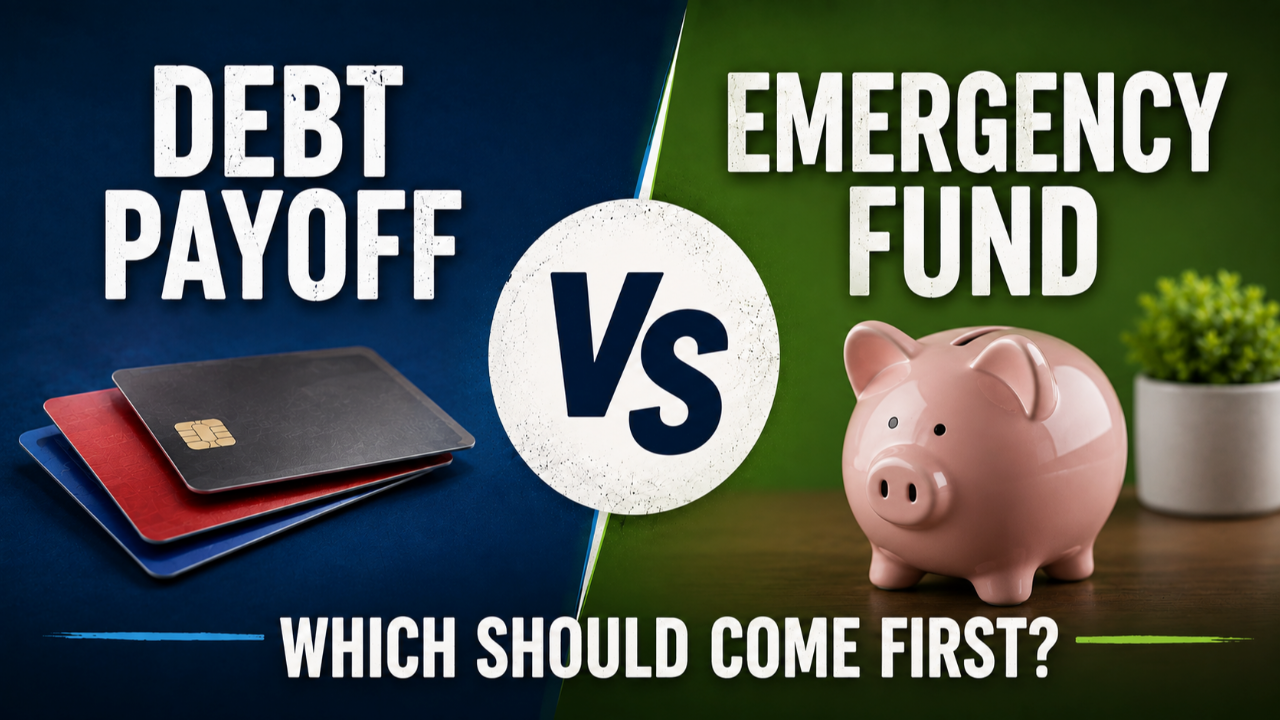
Debt Payoff vs. Emergency Fund: Which Should Come First?
You have some extra money this month.
You also have two financial goals staring at you: debt that needs to disappear and an emergency fund that needs to grow.
Where should the money go? Should you pay off debt or build your emergency fund?
It's a legitimate question because both goals matter. Debt consumes your income and can cost you significantly in interest. An emergency fund protects you when life doesn't go according to plan.
But if you're trying to do both at the same time, progress can feel painfully slow.
So, which should come first?
For most people, paying off non-mortgage debt should come before building a fully funded emergency fund. Here's why.
Debt Is Already Costing You
An emergency fund prepares you for something that might happen. Debt is something that is already happening.
Every month, part of your income is committed to lenders. You may have a car payment, student loan payment, credit card payment, personal loan payment, or some combination of them. Those payments reduce your financial flexibility right now.
And some types of debt are particularly expensive. Credit card interest can make yesterday's purchases significantly more costly while slowing your ability to make meaningful financial progress.
Eliminating debt doesn't just remove a balance from your financial statement. It gives you back part of your paycheck.
Debt Makes Financial Emergencies Worse
One of the primary arguments for building an emergency fund first is protection. That makes sense. But there is another side to consider.
Debt makes emergencies more difficult to handle.
Imagine two households that both experience a job loss. Their basic living expenses are identical, but one household has $1,000 per month in car loans, credit cards, student loans, and other debt payments.
The other household has none.
Which family is in a stronger position? The debt-free household needs less income every month just to stay afloat.
This is one of the overlooked benefits of paying off debt. You're not simply improving today's finances. You're reducing the financial pressure you'll experience if tomorrow doesn't go according to plan.
What About the Interest?
There's also the math.
Suppose you're carrying a credit card balance at 20% or more while putting thousands of dollars into a savings account earning considerably less. Your savings may make you feel safer, but you're paying a significant price for that sense of security.
This doesn't mean cash in the bank has no value. It absolutely does. But there is a cost to maintaining a large amount of cash while simultaneously carrying high-interest consumer debt.
That's why I would generally prioritize eliminating the debt before accumulating three to six months of living expenses.
Don't Try to Do Everything at Once
One of the biggest problems with trying to pay off debt and build a full emergency fund simultaneously is that you divide your financial firepower.
Imagine you have $600 per month available after covering your regular expenses.
You could put $300 toward additional debt payments and $300 toward your emergency fund. Both numbers would move in the right direction.
But slowly.
Or you could focus your resources on eliminating the debt. As each debt disappears, another monthly payment disappears with it.
Then a $100 credit card minimum.
A $250 car payment is eliminated.
Then a $150 student loan payment.
Suddenly, the $600 you originally had available has become $1,100.
Focused financial progress can create momentum.
Then Build the Emergency Fund
Once your non-mortgage debt is gone, it's time to build a serious emergency fund.
In the 8 Money Milestones, Money Milestone 4 is to pay off all non-mortgage debt. Money Milestone 5 is to save three to six months of living expenses for a job-loss-level emergency.
That order is intentional.
Once you've eliminated debt, you're in a much better position to build savings quickly.
Instead of sending hundreds or even thousands of dollars to lenders every month, you can direct that money toward your emergency fund.
And because you've reduced your monthly financial obligations, the amount you need to survive a period without income may be lower as well.
Debt Payoff vs. Emergency Fund: Debt Wins…First
Both are important.
You want to become debt-free and have enough money saved to weather a significant financial storm.
But you don't have to pursue both goals with equal intensity at the same time.
For most people carrying non-mortgage debt, focus first on eliminating the debt. Then take the money that was going toward payments and aggressively build three to six months of living expenses.
There are exceptions. If you know a layoff is coming, your income is unusually unstable, or you're facing another significant financial risk, building additional cash reserves may need to temporarily take priority.
But don't allow fear of what might happen to keep you unnecessarily burdened by what is already happening.
Debt consumes your income today. An emergency fund protects your income tomorrow.
Eliminate the first. Then build the second.